What IsAirway Dentistry?
How the jaw, the tongue, and the palate shape the way you breathe at night


Airway dentistry looks at how the structures of the mouth and jaw affect breathing, especially during sleep. It considers the size and shape of the jaw, where the tongue rests, the shape of the palate, and whether you breathe through your nose or your mouth. When those structures narrow the airway, the result can be snoring, broken sleep, or obstructive sleep apnea. A dentist can screen for the signs; a sleep physician makes the diagnosis.
Most people think of the dentist as someone who looks at teeth. But the mouth is also the front door of the airway. How it is built has a great deal to do with how well you breathe at night.
Why does the mouth affect breathing during sleep?
Very often, a breathing problem at night has a structural cause. Four parts of the mouth and face matter most.
The jaw
The jaw is our real estate. When it does not grow large and wide enough, there is less room for everything inside it, including the tongue.
The tongue
During sleep, the tongue needs room to rest forward, just behind the front teeth. That keeps the back of the throat open. When the jaw is small, the tongue tends to fall back and narrow the airway.
The palate
A narrow or high-arched palate is one of the signs we look for. The roof of the mouth is also the floor of the nose, so its shape affects nasal breathing too.
Nose versus mouth
The nose was designed for breathing. It filters, warms, and humidifies the air, and it supports the body's nitric oxide pathway. Chronic mouth breathing bypasses all of that, and in children it is associated with changes in how the jaw and face develop.12 I explain more in breathing, sleep, sugar, and longevity.
What are the signs of an airway problem?
No single sign confirms a sleep disorder. Together, they form a pattern worth looking into:
- Snoring, or pauses in breathing that a partner notices
- Waking unrefreshed after a full night
- Waking with a dry mouth
- Grinding or clenching at night, and worn enamel3
- A narrow or high-arched palate
- A scalloped edge along the sides of the tongue
- In children: mouth breathing, snoring, or crowded teeth
How is the airway evaluated?
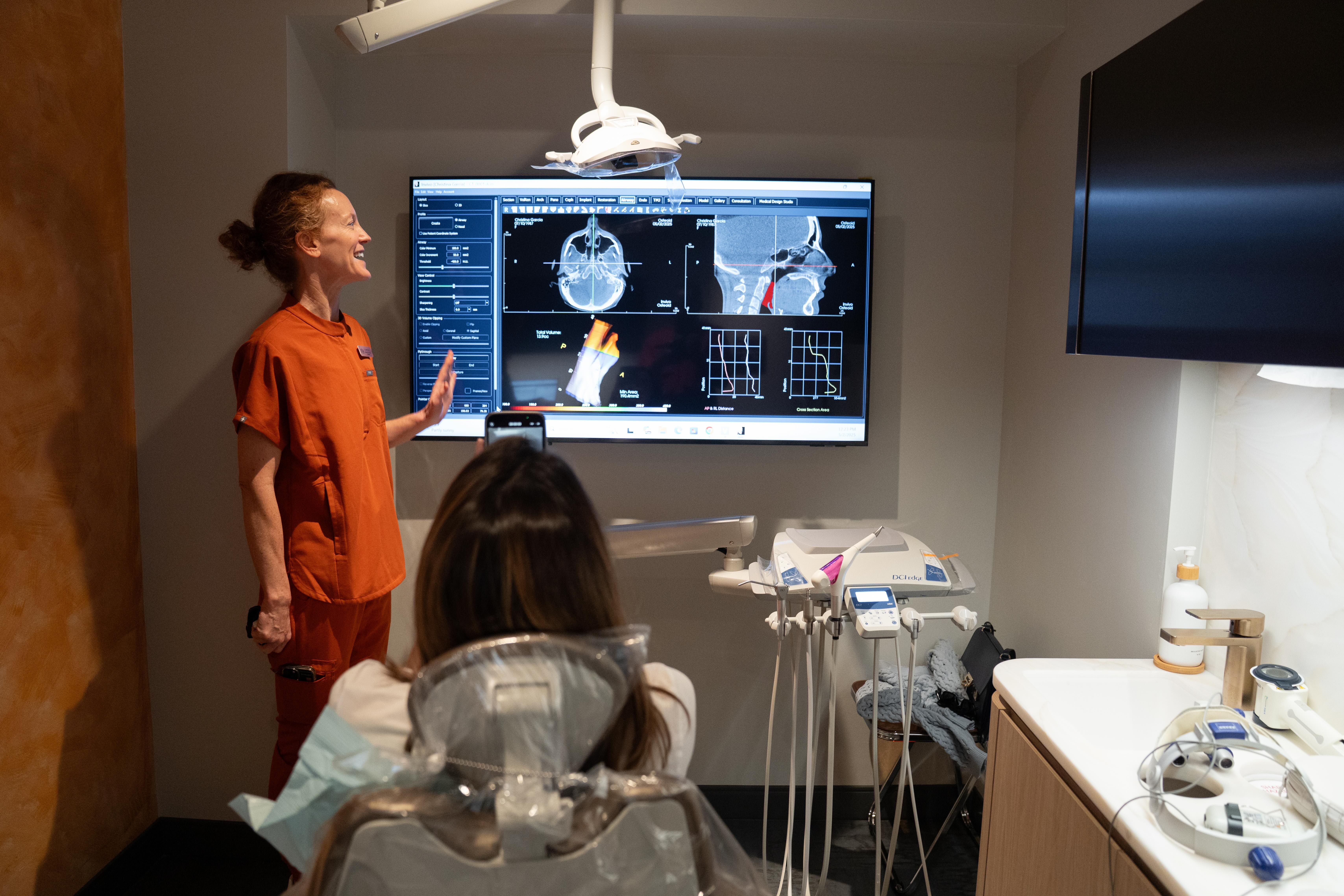
At Smile House, the evaluation starts with the mouth itself: the jaw, the bite, the tongue, the palate, and the wear on the teeth. A 3D cone-beam CT scan of the airway is part of our standard workup. It shows us the size and shape of the airway, often long before anyone has been told they have a sleep problem.
If the signs point to sleep-disordered breathing, the next step is a sleep study. A sleep physician orders and reads it, and makes the diagnosis.
What can airway dentistry do?
Treatment depends on the cause, and often involves more than one specialist.
- Custom oral appliances. Worn at night, they hold the lower jaw slightly forward to keep the airway open. They are a clinically validated option for mild to moderate obstructive sleep apnea and for people who cannot tolerate CPAP.4
- Myofunctional therapy. Exercises that strengthen the muscles of the tongue and throat have been shown to meaningfully reduce the severity of sleep apnea in adults.5
- Orthodontics and palate expansion. In some patients, creating more room in the jaw and palate can help the tongue sit forward and support nasal breathing, in children and in adults.
- Working with your other doctors. Sleep physicians and ear, nose, and throat specialists are often part of the plan, for example when a blocked nose needs treatment.
At Smile House, airway care sits within our sleep and airway dentistry, and how you breathe and sleep is one of the five areas of Mouth Mapping®.
Who should consider an airway evaluation?
Anyone who snores, wakes unrefreshed, grinds their teeth at night, or has been told they breathe through their mouth. Parents who notice their child mouth breathing or snoring should ask too, because a child's jaw is still developing.
If you would like a longevity-focused oral evaluation, our team would be honored to guide you. You can book online, call or text Smile House Tribeca at (212) 725-1111, or call JBL New York City on the Upper East Side at (212) 734-6111.
Good sleep starts with an open airway. The mouth is where we can see it.
Dr. Jonathan B. Levine, DMDQuick answers.
Is airway dentistry the same as treating sleep apnea?
Not exactly. Airway dentistry looks at how the mouth and jaw affect breathing. Sleep apnea is one condition it can help manage, alongside the sleep physician who makes the diagnosis.
Do I need a sleep study?
If an airway problem is suspected, yes. A sleep study is how sleep apnea is diagnosed, and a sleep physician orders and reads it.
Can adults benefit from airway dentistry?
Yes. Adults can benefit from oral appliances, myofunctional therapy, and in some cases orthodontic treatment or palate expansion.