How Dentistry Got Separated From Medicine, and Why ItMatters
Why your mouth is the gateway to your overall health


Why are dentistry and medicine separate?
Not because of biology. In 1840, after the medical faculty in Baltimore declined to add dentistry to its teaching, two dentists, Horace Hayden and Chapin Harris, opened the first dental college in the world. Dentists and physicians have trained separately ever since. The body never made that split.
How we got here
Somewhere along the way, dentistry was separated from medicine. Not in biology. In institutions.
The mouth got its own schools, its own licenses, and later its own insurance. Gradually, the idea took hold that what happens in your mouth stays in your mouth.
That was a miscalculation. Over the last twenty years, the research has told a very different story.
The mouth, the top of the digestive tract, has always been connected to everything else. The heart. The brain. The gut. The immune system. What lives there, what grows there, what breaks down there, finds its way into the rest of the body.123 That is not a brand new discovery. It is something the research has been confirming, steadily, for decades.
We just never built it into the conversation.
What does the evidence show?
Here is the simplest version. Gum disease is a chronic infection, and most people who have it cannot feel it. While it is active, it sends inflammatory signals into the bloodstream around the clock: the same signals associated with heart disease, diabetes, cognitive decline, and accelerated aging.146
I have written about what this means for the gums, the brain, and the rest of the body.
This is not a fringe idea being debated in obscure journals. It is where the evidence has been pointing for a long time.
The mouth often signals first
The mouth does not just participate in what is already happening in the body. It often signals it first.
A patient starts a new medication and their saliva changes. A patient with disrupted sleep comes in grinding and clenching in ways they were not before. A patient managing an autoimmune condition shows shifts in their gum tissue that track with their flares.
These are not coincidences. They are the mouth translating what the rest of the body is going through. This is why I believe a thorough oral evaluation belongs at the center of any serious longevity conversation. Not as an afterthought. As an entry point.
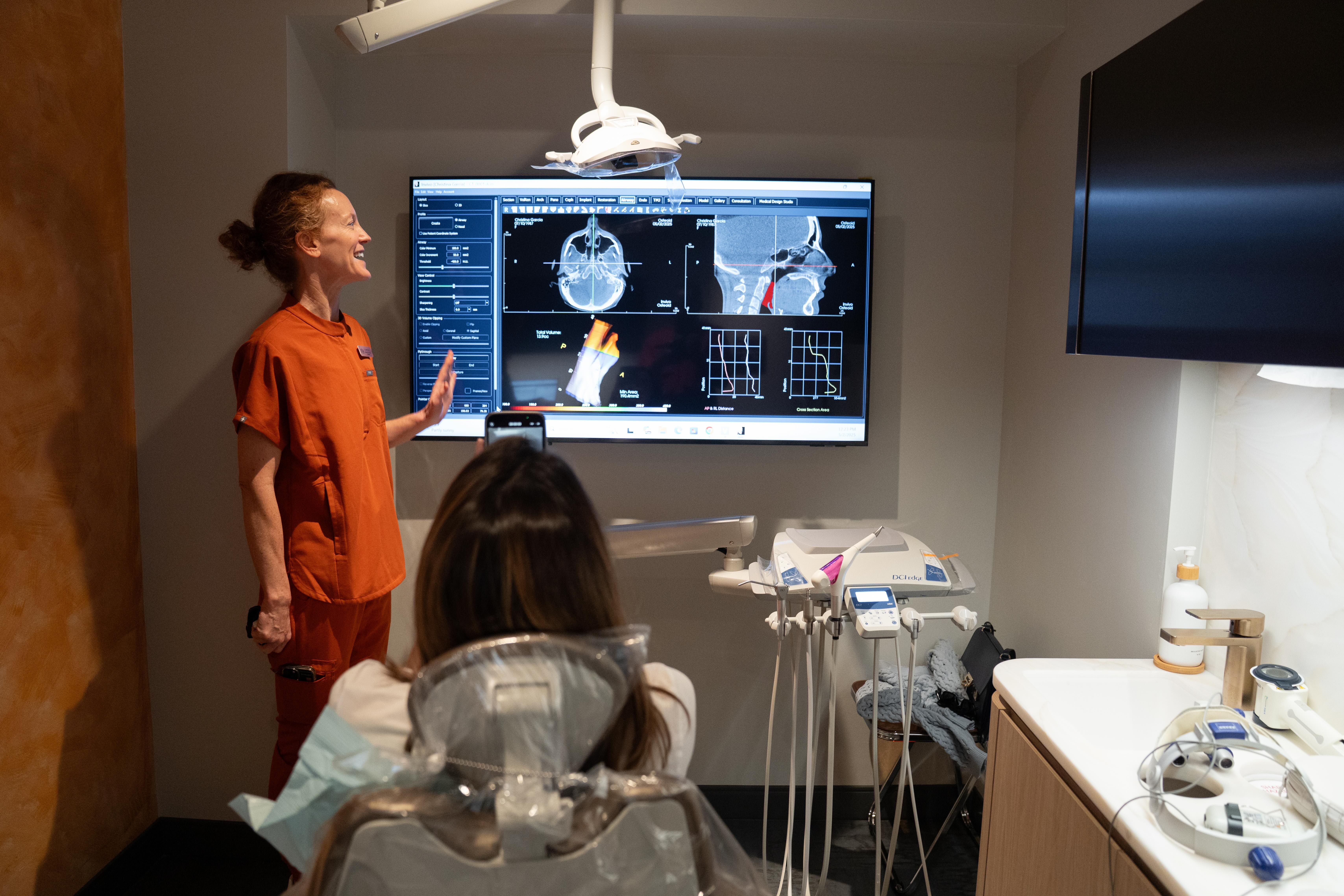
At Smile House, Mouth Mapping® is how we read those signals: looking at the aesthetics, structure, function, and biology of the mouth, and at how you breathe and sleep, together, as one connected picture, not a checklist of isolated dental findings.
What this asks of you
This is not an argument for anxiety. In fact, I have good news.
The steps that protect oral health are not complicated. Regular evaluation that goes beyond a cleaning and actually assesses the gum tissue. Daily brushing and flossing, which research has linked to meaningfully lower cardiovascular risk.5 Attention to dry mouth and acid exposure. Airway screening if sleep feels off. And treating your dental care as part of the same conversation as your heart health, your blood sugar, and your cognitive wellbeing.
Not heroic. Just more complete, and integrated with the rest of your health.
The bigger picture
Every longevity conversation I have eventually arrives at the same place. The body does not divide itself into specialties.
The brain is connected to the heart. The gut is connected to immunity. The airway is connected to sleep. The mouth is connected to all of it.
When we leave the mouth out of that picture, we are missing something that matters. Dentistry, practiced with a systems lens, becomes something more than prevention. It becomes a way of reading signals that the rest of medicine is not yet looking for. That is the idea behind dental longevity.
If you would like a longevity-focused oral evaluation, our team would be honored to guide you. You can book online, call or text Smile House Tribeca at (212) 725-1111, or call JBL New York City on the Upper East Side at (212) 734-6111.
Illumination is where longevity begins.
Dr. Jonathan B. Levine, DMDQuick answers.
Why are dental and medical care separate?
Mostly for historical and institutional reasons. Dentistry developed its own schools, licensing, and insurance, while the biology of the mouth stayed connected to the rest of the body.
Is oral health part of overall health?
Yes. Research links gum disease with heart disease, diabetes, and cognitive decline, though an association is not proof of cause.