
What Your Mouth Has to Do With YourBrain Health
Two pathways most people have never heard of. Both start in the mouth.

Is gum disease linked to Alzheimer's? Here is what the research shows.
Bacteria associated with gum disease have been found in brain tissue from people with Alzheimer's disease, and reviews link gum disease with faster cognitive decline. That is an association, not proof of cause. The second link runs through sleep. Obstructive sleep apnea, shaped in part by the jaw and the airway, is associated with higher dementia risk.
People ask me about teeth. About gums. About how to keep their smile looking good as they age. They rarely ask about their brain.
That is about to change.
Is gum disease linked to Alzheimer's disease?
There are two connections. Neither one is obvious.
Most people who have heard anything about the mouth and systemic health have heard the heart story. The brain story is different, and in some ways more surprising.
The same bacteria that live in infected gum tissue have been found in brain tissue from people with Alzheimer's disease. Not only in the bloodstream. In the brain. Research published in 2024 described pathways between the mouth and the central nervous system: through the blood, through nerve pathways, and through the gut.1
A 2025 scoping review of the research reported an association between gum disease, Alzheimer's disease, and faster cognitive decline.2
One of the most studied bacteria is P. gingivalis. In a 2019 study, researchers found its toxic enzymes, called gingipains, in the brains of people with Alzheimer's, in the same regions as the disease's hallmark damage.7
We are not claiming gum disease causes Alzheimer's. The science has not reached that conclusion yet.
What it has reached is this: what lives in your mouth does not stay in your mouth. And for the brain, that matters more than almost anyone has been told.
How does sleep connect the mouth and the brain?
The brain cleans itself during sleep
The second connection is about sleep. And this one surprises people even more.
There is a system that runs during deep sleep, quietly clearing out the waste products that build up in the brain during the day.6 Among those waste products are proteins linked to Alzheimer's disease. When sleep is repeatedly interrupted, that process is disrupted. Night after night, year after year, that adds up.
Sleep apnea and dementia risk
Obstructive sleep apnea is the condition in which the airway repeatedly collapses during sleep. Here is the part most people do not know: recent large studies and meta-analyses have associated it with higher risk of dementia and cognitive impairment.345
Why your dentist may notice it first
Most sleep problems involve some kind of airway resistance, and very often the cause is anatomical. The person breathes through the mouth instead of the nose. Or the jaw did not grow large and wide enough to give the tongue room to sit forward. When the jaw is small, the tongue tends to fall back during sleep and narrow the airway.
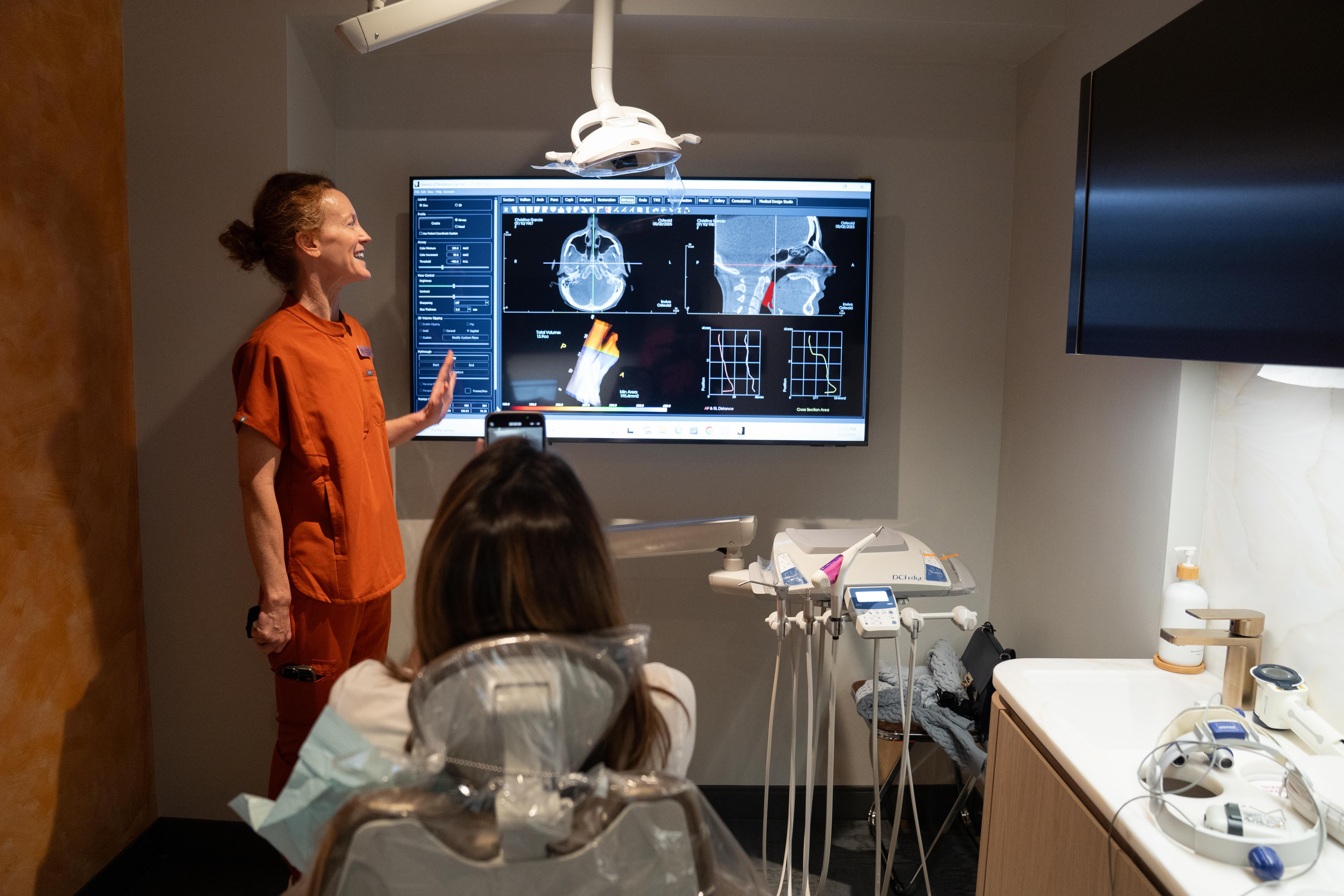
We can see this. At Smile House, a 3D cone-beam CT scan of the airway is part of our standard workup, and it often shows a small airway long before anyone has been told they have a sleep problem.
Dentists trained in airway assessment can often spot the signs before a formal sleep diagnosis is made, and refer you to a sleep physician for testing. That is why airway screening is part of our sleep and airway care.
What are the quiet warning signs?
Neither connection announces itself loudly. Gum disease rarely hurts until it is advanced. A jaw grinding at night does not wake most people up. An airway under strain feels like nothing except morning fatigue that becomes the new normal. The signs worth looking for:
- Gums that bleed when you brush or floss
- Enamel that is flattening or wearing down
- Waking with a tight or sore jaw
- Snoring, or a partner who notices pauses in your breathing
- Morning fatigue that has become routine
What does a mouth-brain evaluation include?
At Smile House, a thorough evaluation looks at wear patterns on the enamel, gum pocket depths, bone levels over time, and the structural features of the jaw and palate. It is part of Mouth Mapping®, and together these findings tell a story that goes well beyond the teeth.
If you have never had your gums measured properly, start with our guide to the periodontal chart most checkups skip.
Why this matters now
The longevity conversation is the most sophisticated it has ever been. People are tracking their sleep, their inflammation markers, their glucose, their cardiovascular risk. They are investing seriously in how they age.
And almost none of that conversation includes the mouth. Not because the connection is not there. Because no one has made it visible yet. That is what this series is for.
If you would like a comprehensive oral evaluation that includes periodontal assessment and airway screening, our team would be honored to guide you. You can book online, call or text Smile House Tribeca at (212) 725-1111, or call JBL New York City on the Upper East Side at (212) 734-6111.
The brain needs allies. The mouth is one of them.
Dr. Jonathan B. Levine, DMDQuick answers.
Does gum disease cause Alzheimer's?
Research shows an association, not cause. Bacteria associated with gum disease have been found in the brain tissue of people with Alzheimer's, but studies have not shown that gum disease causes the disease.
Does treating gum disease prevent dementia?
No study has shown that treating gum disease prevents dementia. Healthy gums matter for many reasons, and the research on brain health is still developing.
Can a dentist diagnose sleep apnea?
No. A sleep physician diagnoses sleep apnea, usually with a sleep study. Dentists trained in airway assessment can spot signs in the jaw, teeth, and airway, and refer you for testing.


